Inverter Battery Health Check: Testing 150Ah–200Ah Home Batteries
Backup time dropping? An inverter battery health check with a 10-second load test tells you whether the battery has actually failed — or whether the problem is charging, water level, or connections — before you buy a new one.
Why backup time drops — it is not always the battery
When the inverter runs for 20 minutes instead of two hours, the battery is the usual suspect, but not the only one. Four things cause short backup, and only one means you need a new battery:
- A genuinely worn battery — plates degraded, cannot hold capacity. A load test confirms this.
- Weak charging — the inverter is not fully charging the battery, so it starts each outage half-full.
- Low electrolyte — in flooded/tubular batteries, water below the plates cuts capacity and damages the battery.
- Loose or corroded terminals — voltage drops at the connection, mimicking a weak battery.
Replacing a good battery because of a charging or water problem wastes money and leaves the real fault in place. The load test is what separates a dead battery from a fixable one.
Before you test: three quick checks
- Fully charge the batteryLet the inverter charge it to full, or use a proper charger. A load test on a half-charged battery reads low because it is low, not because it is bad.
- Check the water level (flooded/tubular)Top up with distilled water to the marked level if the plates are exposed. Never test or charge with plates dry. Sealed/SMF batteries skip this step.
- Clean and tighten the terminalsCorrosion and loose clamps drop voltage on their own and fake a weak result. Wipe the posts and tighten before testing.
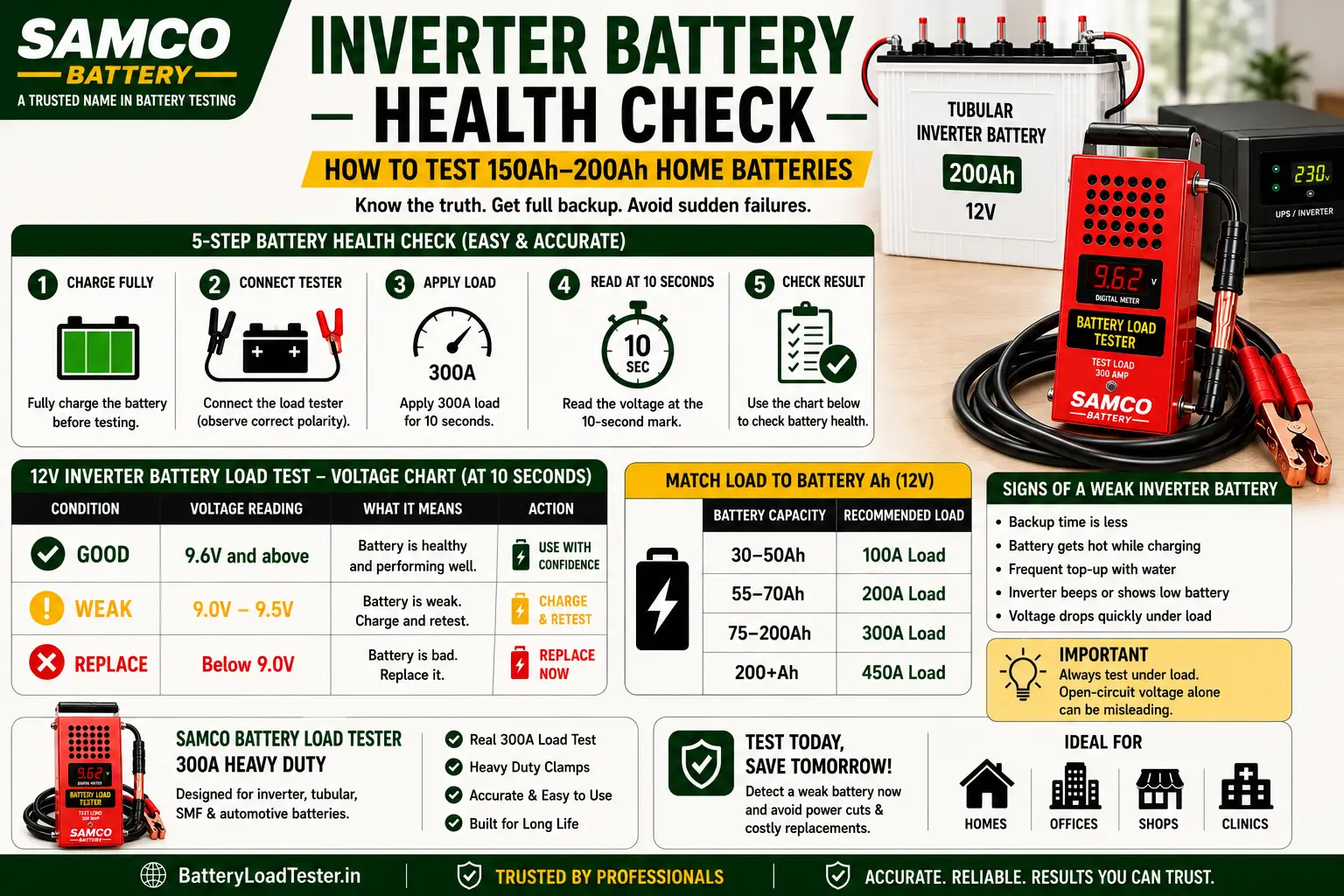
Inverter battery health check: how to load-test it
- Disconnect the battery from the inverterTest the battery on its own so the inverter's circuitry does not affect the reading.
- Note resting voltageA fully charged 12V battery rests at about 12.6–12.8V. Below 12.4V, charge it more before testing.
- Clamp the load tester on, positive to positiveFirm contact matters — a loose clamp gives a false low reading.
- Apply the load for 10 secondsUse a load matched to the battery (300A for a 150–200Ah battery). Hold within the rated time and let the tester cool between tests.
- Read voltage at the 10-second mark, load still ONThis is the number that matters. Compare it to the chart below.
- Watch the recoveryRelease the load. A healthy battery climbs back toward its normal resting voltage quickly; one that stays low, or crawls back, is failing.
Reading the result
Voltage on a fully charged 12V inverter or tubular battery at the 10-second mark, under a load matched to it (300A for a 150Ah–200Ah battery):
| Voltage under load | Verdict | What it means |
|---|---|---|
| 10.0V and above | GOOD | Holds under load comfortably. Battery is healthy — look elsewhere for the backup problem. |
| 9.6V – 9.9V | ACCEPTABLE | Still serviceable. Keep in use and monitor. |
| 9.0V – 9.5V | WEAK | Borderline. Recharge, check water, and retest before replacing. |
| Below 9.0V | FAILED | Failed the test. Recharge fully and retest; replace if it repeats. |
The tool for this job
SAMCO LOAD PRO 300 — Inverter Battery Load Tester (300A)
₹5,757 (GST included, free delivery across India)
Applies a genuine resistive load to any 12V lead-acid battery, 100Ah–200Ah — inverter, tubular, UPS, e-rickshaw and car. Heat-safe grill, heavy-duty clamps, 10-second test — the right tool for home inverter and tubular batteries.
How to make an inverter battery last longer
Once you have a healthy battery, a few habits extend its life:
- Keep the water topped up — check flooded/tubular batteries every 1–2 months and top up with distilled water only, never tap water.
- Let it fully charge — frequent deep discharges without a full recharge shorten life fastest.
- Keep terminals clean — a smear of petroleum jelly on the posts slows corrosion.
- Load-test twice a year — catching a downward trend early lets you plan a replacement instead of losing power during an outage.
Frequently asked questions
How do I know if my inverter battery is dying or the inverter is faulty?
Why has my inverter backup time dropped so much?
What load should I use on a 150Ah or 200Ah tubular battery?
What voltage means my inverter battery must be replaced?
Should the battery be fully charged before testing?
Can I test the battery without disconnecting the inverter?
How do I test a 24V or 48V inverter bank?
Why does my multimeter say 12.6V when the backup is still poor?
How often should an inverter battery be checked?
Can the same tester check e-rickshaw and solar batteries?
When to run an inverter battery health check
Load testers by battery size
More battery testing guides
Voltage thresholds are practical reference ranges for 12V lead-acid battery load testing and are guidance, not a guarantee for every battery or condition. Add distilled water only; follow your battery maker's instructions. Prices are inclusive of GST and subject to availability. © 2026 Samco Battery