Battery Load Tester vs Multimeter vs Electronic Tester
Battery load tester vs multimeter vs electronic tester: three tools, three different questions. Here is what each one actually measures, when a multimeter is not enough, and which one tells you whether a battery will crank the engine.
01What each tool actually measures
The three get called "battery testers" interchangeably, but they answer different questions:
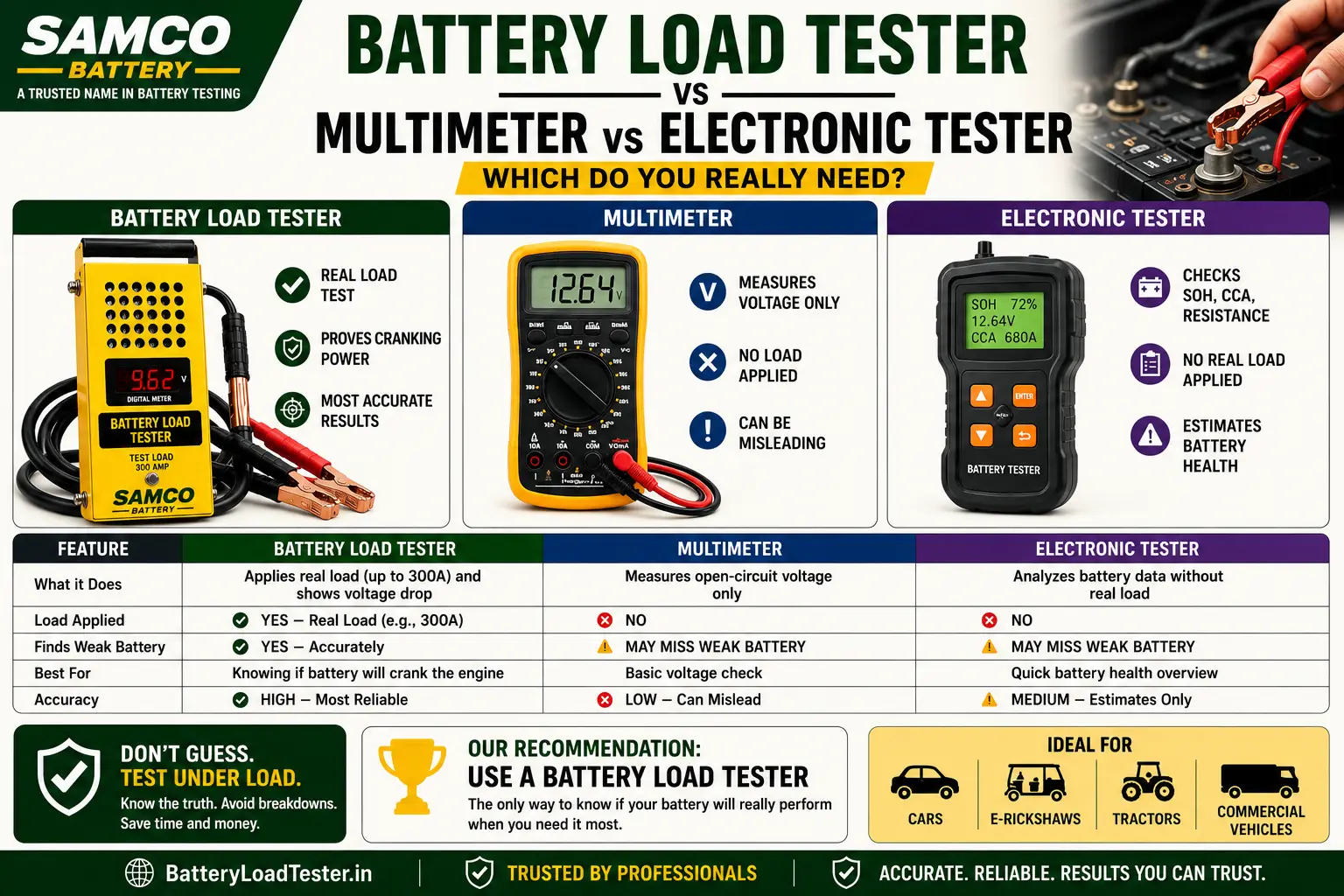
- Multimeter — measures voltage (and current, resistance) with no load applied. It tells you the state of charge, not the state of health. A reading of 12.6V means "charged," not "good."
- Electronic / impedance tester — sends a small signal through the battery and estimates internal resistance and health, often reporting CCA. It can test a battery that is not fully charged and does not need a heavy load, which makes it fast and convenient.
- Load tester — applies a genuine heavy load (often hundreds of amps) for about 10 seconds and shows the voltage while the battery is working. This reproduces cranking and reveals weak cells that only show up under real demand.
02Side by side
| Multimeter | Electronic tester | Load tester | |
|---|---|---|---|
| Measures | Voltage / charge | Internal resistance, estimated health | Voltage under real load |
| Applies a load? | No | Tiny signal only | Yes — heavy, real |
| Needs full charge? | To judge charge | No | Yes |
| Proves it will crank? | No | Estimate | Yes |
| Reads across battery types | Any DC | Depends on unit | 12V/24V lead-acid |
| Best for | Quick charge check | Fast health estimate, discharged batteries | Straight good/weak/replace verdict |
03Battery load tester vs multimeter: when a multimeter is not enough
A multimeter is the most common tool and the most commonly misread. The trap: a battery with worn or sulfated plates can hold a healthy 12.6V at rest and still collapse the moment the starter pulls current. The multimeter shows 12.6V and calls it fine; the car will not start.
A multimeter is still worth keeping: use it to confirm the battery is fully charged before a load test, and to check charging voltage (about 13.8–14.4V at the terminals with the engine running) afterwards. In the battery load tester vs multimeter question, they complement each other rather than one replacing the other.
04Load tester vs electronic tester: which for a workshop?
Both give a health verdict, and both have a place. The practical differences:
- Electronic testers are fast, work on partly charged batteries, and print a CCA number. They shine for high-volume counter checks and for batteries too flat to load test.
- Load testers apply real current, so there is no estimation — you watch the voltage hold or sag. They are rugged, simple, need no calibration maps, and cost far less. For a workshop that wants an unambiguous good/weak/replace call on 12V lead-acid batteries, a resistive load tester is hard to beat on value.
Many workshops keep both: an electronic tester for speed, a load tester for the final word when a battery is borderline.
The straight-verdict tool
SAMCO Battery Load Testers
From ₹2,415
Resistive load testers that apply real current to 12V lead-acid batteries — two-wheeler, car, tractor, e-rickshaw and inverter. No calibration maps, no guesswork. Delhi dispatch, Pan-India delivery.
Ask on WhatsApp05Which should you buy?
The battery load tester vs multimeter choice comes down to the question you need answered:
- You just want to know if it is charged — a multimeter is enough, and you may already own one.
- You need a fast health estimate, often on flat batteries — an electronic tester earns its place, especially at a busy counter.
- You need to prove a 12V battery can crank, cheaply and unambiguously — a load tester is the right call. Match the load to the battery size (roughly 3× the Ah rating), and read our readings chart for the pass/fail numbers.
06Frequently asked questions
Can I test a car battery with just a multimeter?
Is a load tester better than an electronic tester?
Do I still need a multimeter if I have a load tester?
Why does my battery pass on a multimeter but the car won't start?
What load current do I need on the load tester?
Guidance is general and applies to 12V/24V lead-acid batteries; it is not a guarantee for every battery or condition. Prices are subject to availability. © 2026 Samco Battery