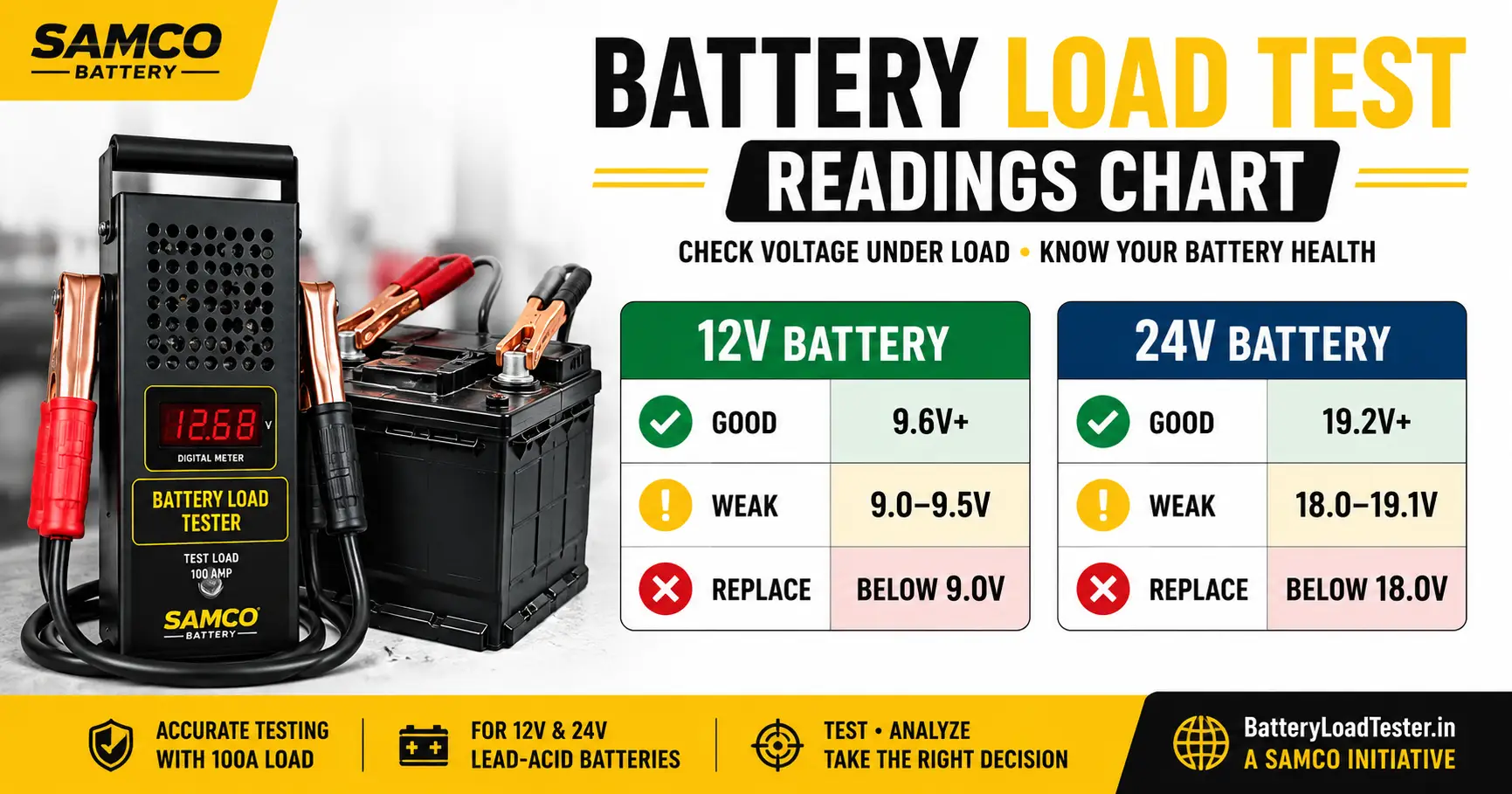
Battery Load Test Readings Chart: Good, Weak, Replace
This battery load test readings chart gives the voltage numbers that decide good, weak, or replace — for 12V and 24V lead-acid batteries. Bookmark it as your workshop reference.
12V battery load test readings chart
Voltage measured while the load is applied, on a fully charged 12V lead-acid battery at the 10-second mark:
| Voltage under load | Verdict | What it means |
|---|---|---|
| 10.0V and above | GOOD | Holds cranking load comfortably. Battery is healthy. |
| 9.6V – 9.9V | ACCEPTABLE | Still serviceable. Keep in use and monitor. |
| 9.0V – 9.5V | WEAK | Borderline. Recharge and retest before deciding. |
| Below 9.0V | FAILED | Failed the test. Recharge fully and retest; replace if it repeats. |
24V load test chart
For 24V systems — trucks, buses, some commercial equipment. If your tester works on 12V blocks, test each 12V battery separately and use the 12V chart instead.
| Voltage under load | Verdict | What it means |
|---|---|---|
| 20.0V and above | GOOD | Holds cranking load comfortably. System is healthy. |
| 19.2V – 19.9V | ACCEPTABLE | Still serviceable. Keep in use and monitor. |
| 18.0V – 19.1V | WEAK | Borderline. Recharge and retest; check both batteries. |
| Below 18.0V | FAILED | Failed the test. Recharge fully, retest, then test each 12V block. |
Resting voltage vs state of charge
Before you load-test, the battery should be fully charged. Use this to check charge level with a multimeter at rest (no load, engine off, ideally after the battery has sat an hour):
| Resting voltage (12V) | Resting voltage (24V) | Approx. state of charge |
|---|---|---|
| 12.6 – 12.8V | 25.2 – 25.6V | ~100% — ready to load test |
| 12.5V | 25.0V | ~75% |
| 12.4V | 24.8V | ~50% — action floor: charge before testing |
| 12.2V | 24.4V | ~25% — recharge first |
| 12.0V or less | 24.0V or less | Flat — do not load test yet |
Match the load to the battery size
The load has to be heavy enough to stress the battery. On an automotive cranking battery, use half the CCA rating printed on the label — that is the figure the test is built around. Where no CCA is marked, as on inverter, tubular and traction batteries, use roughly three times the amp-hour rating as a comparative load. Hold it for about 10 seconds. Above about 150Ah the arithmetic outruns what a portable resistive tester can dissipate, so 300A–450A is the practical ceiling. Too light a load lets a weak battery pass.
| Battery type | Typical Ah | Load needed | SAMCO tester |
|---|---|---|---|
| E-bike / two-wheeler | 12–30Ah | ~60A | BCT-6 (60A) |
| Small / mid car | 30–50Ah | ~100A | LoadPro 100 (CBLT-100) |
| Large car / SUV | 55–70Ah | ~200A | BCT-200 (200A) |
| Inverter / tubular / solar | 75–200Ah | ~300A | LOAD PRO 300 (300A) |
| E-rickshaw traction block | 100–150Ah | ~300A | ERLT-300 (300A) |
| Truck / tractor / commercial | 200Ah+ | up to 450A | BCT-700 HRD (450A) |
How to use these numbers
This battery load test readings chart only holds if the test is done right. Four things decide whether the reading is trustworthy:
- Full charge first. Read the resting-voltage chart above and charge to 100% before load testing.
- Matched load. Use the sizing table — an undersized load makes a weak battery look fine.
- Read under load. The number that counts is at the 10-second mark while the load is still applied, not after you release it.
- Mind the temperature. Batteries read lower in cold weather; a marginal winter reading may recover in warmer conditions.
Pick the right tester
SAMCO Battery Load Testers
From ₹2,415
Fixed and multi-level resistive load testers for 12V lead-acid batteries — two-wheeler, car, tractor, e-rickshaw and inverter. Delhi dispatch, Pan-India delivery.
When to run a battery load test
More battery testing guides
Frequently asked questions
What voltage is a bad 12V battery under load?
What should a 24V system read under load?
How much load should I apply?
Does the battery need to be fully charged first?
How long should the load stay on?
Does temperature change the pass threshold?
Why does my battery read 12.6V but still fail?
Can I use these figures for a lithium or LiFePO4 battery?
Why does the LOAD PRO 300 show three bands instead of four?
Which tester should I use for my battery size?
Voltage thresholds and state-of-charge figures are standard references for lead-acid batteries and are guidance, not a guarantee for every battery, temperature or condition. Prices are subject to availability. © 2026 Samco Battery