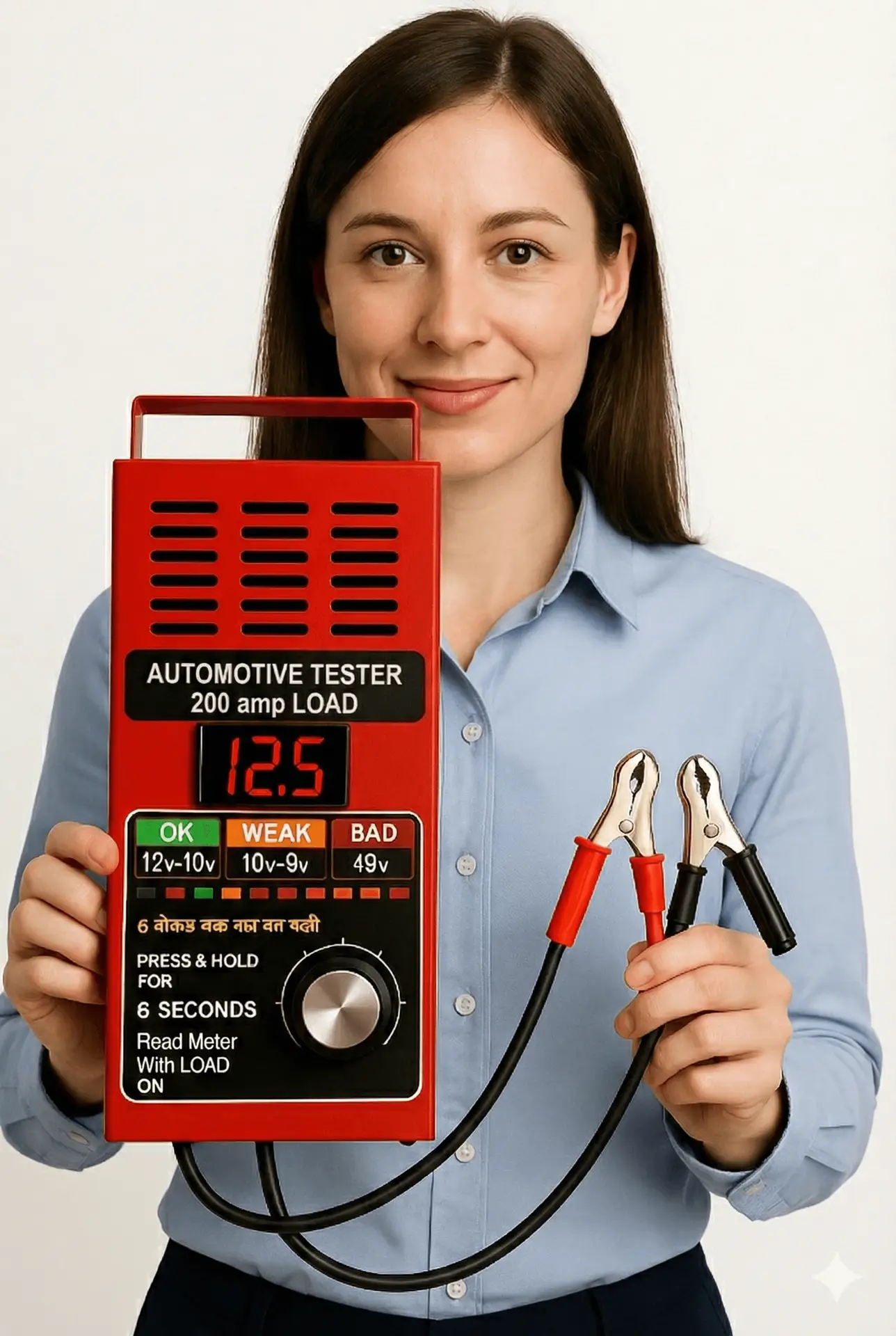
Automotive Battery Load Tester 200A 12V (BCT-200)
Fixed 200 amp load and a digital meter that apply a substantial electrical load to 12V car and SUV batteries in the 60–100 Ah range, revealing voltage sag that resting voltage alone cannot reliably show. Actual cranking current varies with engine size, temperature and starter condition, so this is a diagnostic load test rather than a reproduction of cranking. Built for garages, workshops and battery dealers.
Why this 200A automotive battery load tester?
- Fixed 200A load applies a heavy, repeatable draw on 12V car and SUV batteries.
- Verdict in 10 seconds — good, acceptable, weak or failed.
- Digital meter shows loaded voltage clearly in workshop and roadside light.
- Heavy-duty heating element with cooling vents for repeated tests.
- Heavy-duty clamps with strong spring tension for low-loss connections.
- Portable with a carry handle — move it between bays easily.
How to load test a car battery with the BCT-200
Charge the battery fully
Ideally test a fully charged battery — typically 12.6–12.8V at rest. A half-charged battery gives a false low reading, so charge it further first.
Connect the clamps
Red to positive (+), black to negative (−). Firm contact matters — a loose clamp reads low.
Apply the 200A load for 10 seconds
Press and hold the load switch for a full 10 seconds without releasing.
Read the voltage while the load is on
Note the loaded voltage at the 10-second mark. This reading is a key indicator of the battery’s condition under load.
Release and let it cool
Release the load and allow about a minute between tests, especially in hot weather.
Battery health — loaded voltage at 10 seconds
| Loaded voltage | Condition | Action |
|---|---|---|
| ≥ 10.0 V | Good | Keep in service |
| 9.6 – 9.9 V | Acceptable | Serviceable |
| 9.0 – 9.5 V | Weak | Recharge & retest |
| < 9.0 V | Failed | Recharge, retest, replace if it repeats |
These are SAMCO’s practical interpretation thresholds for a fully charged 12V lead-acid battery tested with the BCT-200 for approximately 10 seconds, not an industry standard. Battery manufacturer specifications should take priority where available.
For 12V and 24V thresholds across all battery types, see the full battery load test readings chart.
BCT-200 specifications
| Model | BCT-200 |
|---|---|
| Load current | Fixed 200 A |
| Rated voltage | 12 V |
| Battery capacity | 60 – 100 Ah |
| Test duration | 10 seconds |
| Display | Digital meter |
| Battery type | 12V lead-acid — flooded, SMF, VRLA |
| Clamps | Heavy-duty insulated |
| Typical use | Garages, battery shops, PDI bays, service stations |
| MRP | ₹4,397 (GST included) |
Frequently asked questions
Which batteries can I test with this 200A load tester?
It is designed for 12V lead-acid car and SUV batteries, typically 60–100Ah. Flooded, SMF and VRLA automotive batteries are all suitable. For 30–50Ah use the 100A tester; for 100Ah and above, use an appropriately rated 300A or higher tester.
How long should the 200A load stay on?
Hold the load for 10 seconds, then release. Do not exceed that continuously, and allow about a minute of cool-down between tests.
How do I read the result?
Read the voltage while the load is still applied, at the 10-second mark. 10.0V and above is good, 9.6–9.9V acceptable, 9.0–9.5V weak (recharge and retest), below 9.0V means it has failed the test — recharge fully, retest, and replace if it repeats.
What voltage means the car battery must be replaced?
Under a 200A load, anything below 9.0V means the battery has failed the test — recharge fully, retest, and replace if it repeats. Between 9.0V and 9.5V it is weak — recharge it fully and retest before deciding.
Can the BCT-200 test a 24V truck or tractor battery?
No. The BCT-200 is designed for one 12V battery at a time. A 24V system is two 12V batteries in series. Do not connect the tester across the complete 24V pack. Testing individual 12V batteries should only be done after the series connections have been safely isolated, following the battery or vehicle manufacturer’s procedure.
Can I use it on a lithium-ion or LiFePO4 battery?
No. The BCT-200 is designed only for 12V lead-acid batteries. Do not connect it to lithium-ion or LiFePO4 batteries; their protection systems and electrical characteristics are different.
How is a load tester different from a multimeter?
A multimeter can show a normal resting voltage even when a battery has poor performance under load. A load tester draws real current and shows what the battery does under strain. See the full comparison in our load tester vs multimeter guide.
Is it suitable for daily garage use?
Yes. It is built for repeated workshop testing with a heavy-duty heating element and cooling vents. Follow the load duration and cool-down between tests.
Is Cash on Delivery available? What about UPI?
Yes. Both Cash on Delivery and UPI are accepted across India. Price ₹4,397 all-inclusive, with free delivery in 3–7 working days from Delhi.
What is the warranty and return policy?
Manufacturer warranty with a 7-day return window. Full terms at samcobattery.in/warranty-return-policy/.
Who uses the BCT-200 automotive battery load tester
Workshops & Garages
A 10-second 200A test per vehicle keeps bay turnaround fast on busy service days.
Car & SUV Owners
Check a 60–100Ah battery before a long drive instead of waiting for a no-crank morning.
Battery Dealers
Settle warranty claims at the counter with a load reading rather than an argument over resting voltage.
Auto Electricians
Separate a genuinely dead battery from a charging-system fault before replacing parts.
Taxi & Fleet Operators
Screen a fleet monthly and retire weak batteries before they strand a driver mid-shift.
Used Car Buyers
Test the battery before you pay — the cheapest fault to find and the easiest to miss.