How to Load-Test a Car Battery in 10 Seconds
A resting voltage reading can call a dying battery healthy. A load test cannot. Here is how to load test a car battery under real cranking load in 10 seconds, read the result, and match the tester to your battery size.
Why resting voltage is not enough
A car battery can read a perfect 12.6V sitting on the bench and still fail to crank the engine. Resting voltage only shows surface charge — it says nothing about whether the plates can deliver current. A battery with sulfated or worn plates holds its resting voltage but collapses the instant the starter draws hundreds of amps.
A properly matched load test is the direct practical check of how the battery responds when substantial current is drawn. It pulls a heavy current through the battery while you watch the voltage. A good battery barely flinches; a weak one drops like a stone. That drop is the diagnosis, and learning how to load test a car battery correctly turns a guess into a clear pass or fail.
Match the load to the battery
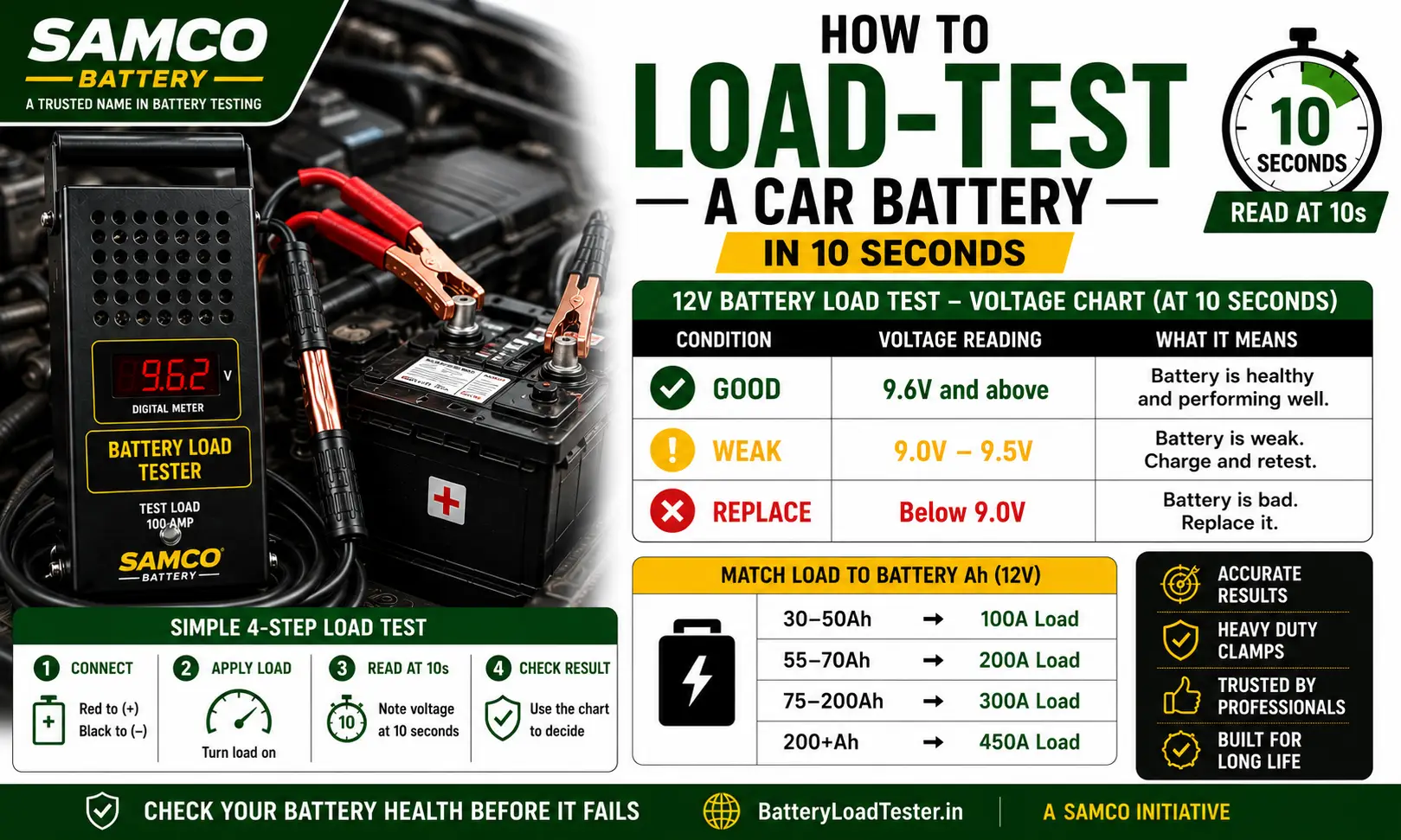
The load has to be heavy enough to stress the battery, or the test tells you nothing. For a car battery the reference load is half the rated CCA, held for about 10 seconds. Where the CCA figure has worn off the label, roughly three times the amp-hour rating is the usual field substitute. Above about 150Ah a practical 300A–450A is the ceiling on portable resistive testers.
| Battery size | Load needed | Right tester |
|---|---|---|
| 30–50Ah | ~100A | LoadPro 100 (100A) — small/mid car |
| 55–70Ah | ~200A | BCT-200 (200A) — large car / SUV |
| 75–200Ah | ~300A | LOAD PRO 300 (300A) — diesel / SUV / inverter |
| 200Ah+ | ~450A | BCT-700 HRD (450A) — heavy commercial |
A 100A load on a 90Ah diesel battery is too light — it will pass a battery that would fail in the car. For larger batteries, step up to a higher-current tester so the load actually simulates cranking.
How to load test a car battery, step by step
Here is how to load test a car battery from start to finish — six steps, a couple of minutes of work:
- Start with a fully charged batteryA load test on a half-charged battery fails for the wrong reason. A healthy 12V battery should rest at about 12.6–12.8V. If it is below 12.4V, charge it fully first.
- Clean the terminalsCorrosion or grease adds resistance and drops voltage on its own, faking a bad result. Wipe the posts clean before clamping.
- Clamp on, positive to positiveAttach the tester's clamps to the matching terminals with firm spring tension. A loose clamp gives a false low reading.
- Apply the load for 10 secondsPress and hold the load knob. Hold for 10 seconds only — do not exceed the rated time, and let the tester cool for about 60 seconds before the next test, especially in summer.
- Read voltage at the 10-second mark, load still ONThis is the number that matters. Reading after you release the load hides the weakness. Compare it against the chart below.
- Watch the recoveryRelease the load. A healthy battery climbs back toward its normal resting voltage within a few seconds. One that stays low, or drifts up slowly, is on its way out even if it just scraped past the under-load figure.
Reading the result: the 12V load-test chart
Voltage measured while the load is applied, on a 12V car battery that started fully charged (for 24V systems and full sizing, see the complete battery load test readings chart):
| Voltage under load | Verdict | What it means |
|---|---|---|
| 10.0V and above | GOOD | Holds up under cranking load comfortably. Battery is healthy. |
| 9.6V – 9.9V | ACCEPTABLE | Still serviceable. Keep in use and monitor. |
| 9.0V – 9.5V | WEAK | Borderline. Recharge and retest; if it repeats, plan to replace. |
| Below 9.0V | FAILED | Failed the test. Recharge fully and retest; replace if it repeats. |
The tool for this job
SAMCO LoadPro 100 — Car Battery Load Tester (100A, CBLT-100)
₹3,111 (GST included, Delhi dispatch, Pan-India delivery)
A true 100A load on 12V lead-acid batteries with a clear digital readout in 10 seconds. Ideal for 30–50Ah, the everyday car range. For 55–70Ah step up to the BCT-200 (200A); for 75Ah+ diesel and SUV batteries use the LOAD PRO 300 (300A).
Don't stop at the battery: check the charging system
If the battery passes but the car still struggles to start, the problem may be the alternator, not the battery. After a good load test, start the engine and check that the charging voltage sits around 13.8–14.4V at the battery terminals. Much lower means the alternator is not charging; much higher can mean a faulty regulator that will cook the battery over time.
A weak battery and a weak alternator produce similar symptoms — slow cranking, frequent jump-starts — so testing both saves a wasted battery replacement.
Frequently asked questions
Is a 100A load tester enough for my car?
How much load should I apply to a car battery?
How long should the load stay on?
What voltage means my car battery is bad?
Do I need to charge the battery before load testing?
Why does my car battery read 12.6V but still not start the car?
Can I load test a battery without removing it from the car?
The battery passes but the car still will not start — what next?
Does cold weather change the result?
Which tool should I buy for testing car batteries at home?
When to load test a car battery
Load testers by battery size
More battery testing guides
Voltage thresholds are standard references for 12V lead-acid batteries and are guidance, not a guarantee for every battery or condition. Prices include GST and are subject to availability. © 2026 Samco Battery