E-Rickshaw Battery Testing: Find the Weak 12V Block Before It Strands You
A 48V or 60V e-rickshaw pack is only as strong as its weakest 12V battery. E-rickshaw battery testing means load-testing each block in 10 seconds, comparing the readings, and deciding whether one battery or the whole set needs replacing.
Why a whole pack "dies" when one battery is weak
An e-rickshaw runs a series string — typically four 12V batteries for a 48V pack, or five for 60V. Because they are wired in series, the same current flows through every battery. When one block loses capacity, it cannot keep up under load, its voltage collapses first, and the controller cuts power or the range drops sharply. The other three batteries can be perfectly healthy.
This is why drivers who replace the entire set are often wasting money. Three good batteries get thrown out with one bad one. A load test tells you exactly which block is failing so you replace one battery instead of four.
What you need
- A load tester rated for the current — e-rickshaw traction batteries are usually 100Ah–200Ah tubular blocks, and 300A is the practical load size for that range. These are deep-cycle batteries rated on slow discharge, not CCA, so a high-current pull is a comparative stress check rather than a standards-defined test: what matters is comparing every block in the same pack under the same load, temperature and state of charge. A small automotive tester will not load these batteries meaningfully.
- A multimeter (optional) to log resting voltage before you start.
- Clean terminals — corrosion or a loose clamp gives a false low reading. Wipe the posts and get firm metal-to-metal contact.
E-rickshaw battery testing, block by block
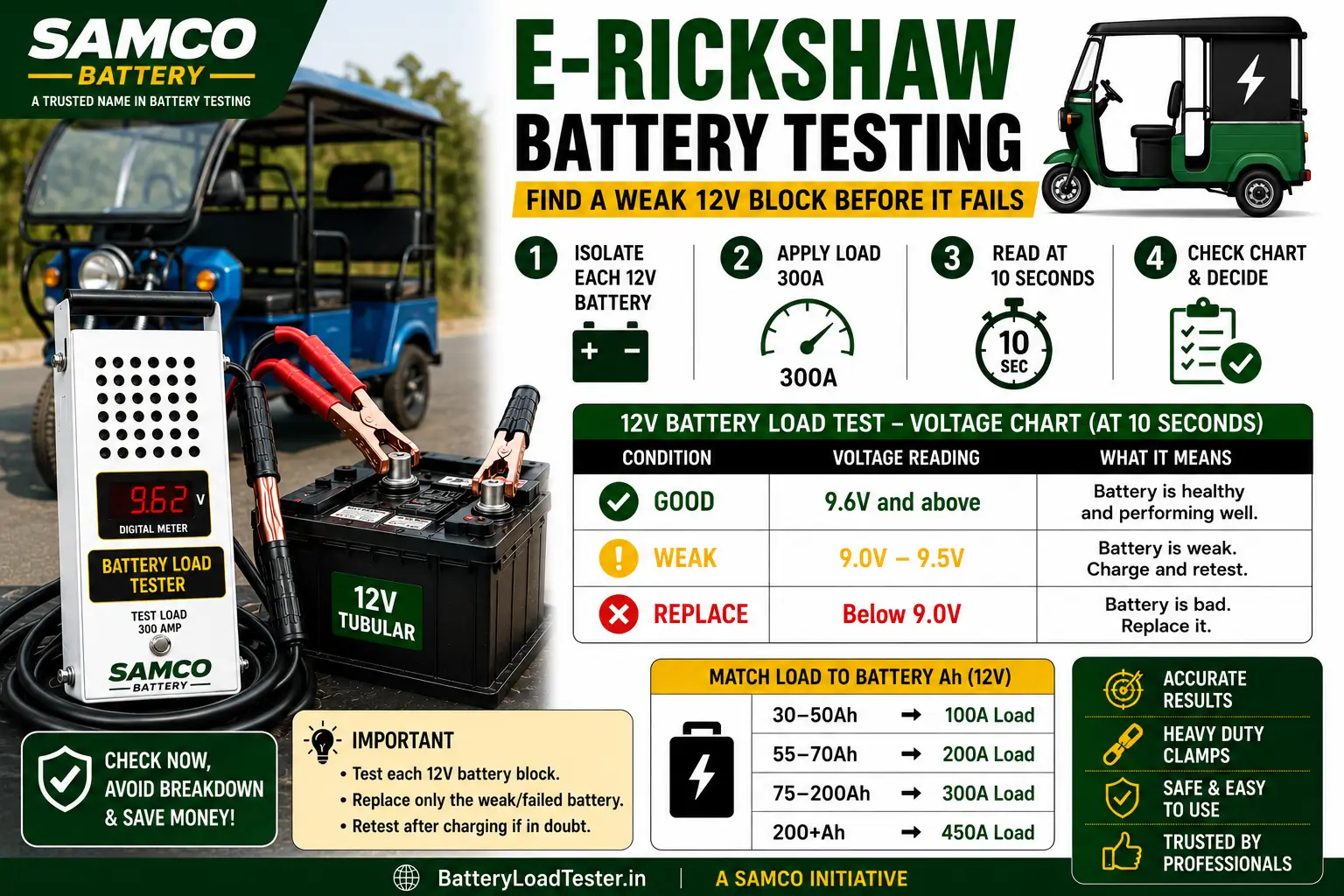
- Disconnect and isolate one batteryWork on one 12V block at a time. Note its position in the string so you can trace a weak result back to the exact battery.
- Check resting voltage firstA fully charged 12V block should read about 12.6–12.8V at rest. If a battery is already sitting below 12.4V, charge it fully before load testing — a flat battery fails a load test for the wrong reason.
- Clamp on, positive to positiveAttach the tester's clamps to the matching terminals with firm tension. A loose clamp drops voltage on its own and skews the reading.
- Apply the 300A load for 10 secondsPress and hold the load knob. Do not exceed the rated time, and let the tester cool between blocks — especially in summer.
- Read voltage at the 10-second mark, load still ONThis is the number that matters. Reading after you release the load hides the weakness. Compare it against the chart below.
- Watch the recoveryRelease the load. A healthy block climbs back toward its normal resting voltage quickly. One that stays low, or crawls back, is on its way out even if it scraped past the under-load number.
- Repeat for every block, then compareLine up all four (or five) readings. The odd one out — the block that sagged lowest under load and recovered slowest — is your culprit.
Reading the result: the 12V load-test chart
Voltage measured while the 300A load is applied, on a 12V lead-acid block that started fully charged (for the full 12V and 24V thresholds, see the battery load test readings chart):
| Voltage under load | Verdict | What it means |
|---|---|---|
| 10.0V and above | GOOD | Holds up under real current comfortably. Keep it in the pack. |
| 9.6V – 9.9V | ACCEPTABLE | Still serviceable. Keep in the pack and monitor. |
| 9.0V – 9.5V | WEAK | Borderline. Recharge and retest; if it repeats, plan to replace soon. |
| Below 9.0V | FAILED | Failed the test and dragging the pack. Recharge fully and retest; replace this block if it repeats. |
The tool for this job
SAMCO ERLT-300 — E-Rickshaw Battery Load Tester (300A)
₹5,757 (GST included, free delivery across India)
Applies a genuine 300A resistive load to any 12V lead-acid block, 100Ah–200Ah. Built for Indian e-rickshaw workshop conditions — heat-safe grill, heavy-duty clamps, 10-second test.
How often should a workshop test e-rickshaw packs?
For a fleet or a busy workshop, load-test packs on a schedule rather than waiting for a breakdown: at every full charge cycle for high-use vehicles, and at minimum once a month. Catching a weak block early lets the driver replace one battery on their own timing instead of getting stranded and paying for a full set under pressure.
Keep a simple log per rickshaw — four voltage readings per test, dated. A block that trends downward across two or three tests is telling you it will fail soon, well before it drops below 9.0V.
Frequently asked questions
Why does my whole e-rickshaw pack die when only one battery is weak?
How do I test a 48V or 60V e-rickshaw pack?
What load should I apply to an e-rickshaw battery?
What voltage means an e-rickshaw battery must be replaced?
Do I have to replace all four batteries at once?
Should the pack be fully charged before testing?
How often should a driver test their own e-rickshaw pack?
Can I use this tester on a lithium-ion e-rickshaw battery?
Why does a multimeter say the battery is fine?
Can the same tester check inverter and tubular batteries?
When to test an e-rickshaw battery pack
Load testers by battery size
More battery testing guides
Voltage thresholds are standard references for 12V lead-acid batteries and are guidance, not a guarantee for every battery or condition. Prices are inclusive of GST and subject to availability. © 2026 Samco Battery